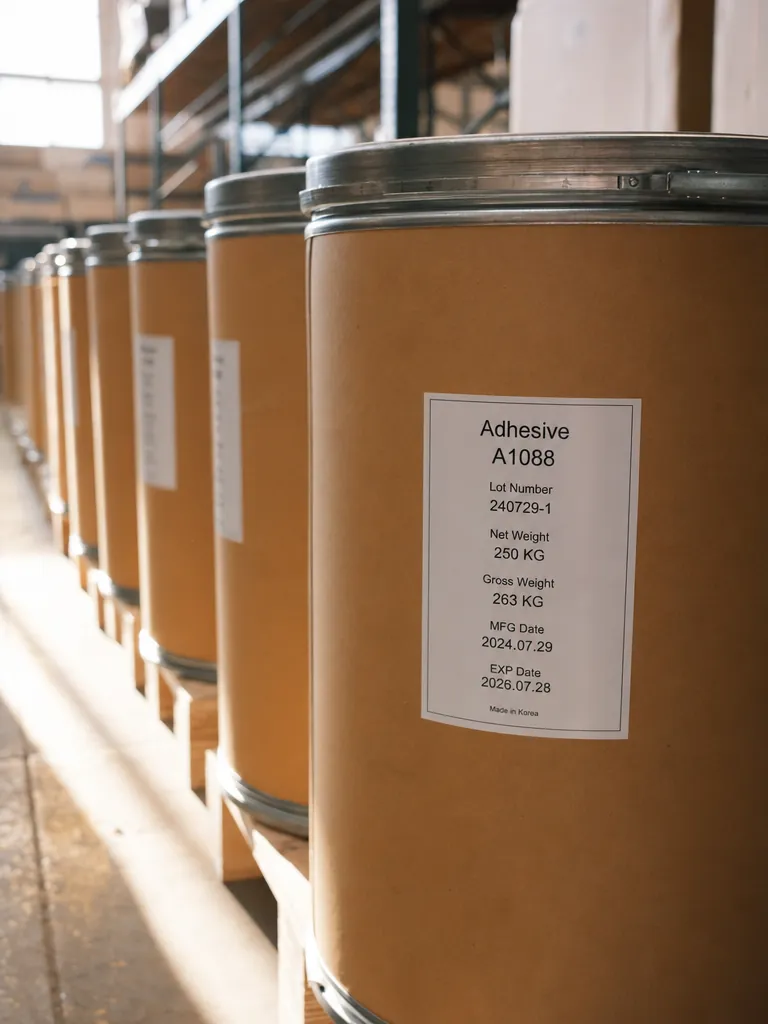
Approved GHS templates
Pictograms, H- and P-statements and batch data are designed once and reused on every site.
New: TFORMer Designer V9.2 — easily design and print labels and forms. Explore the product →

GHS & CLP
Pictograms, H- and P-statements, batch data and every language your markets need.


A hazard label is the last line of defence between a substance and the person handling it. TEC-IT drives GHS and CLP labels from the data your SDS system already holds — the same pictograms, the same statements, the same layout, in every language and at every site.
Generate each label variant from your current safety data.
A hazard classification is updated centrally, and somewhere a plant is still printing last year's pictogram set. Multiply that by the languages you ship into, the pack sizes you fill and the sites that print locally, and label control becomes the hardest part of chemical compliance. TEC-IT makes the label a rendering of your SDS data rather than a document maintained beside it — so a classification change propagates instead of being reissued.

H.B. Fuller
“I confidently recommend TEC-IT.”
Global Labeling Manager, H.B. Fuller
Read customer story ›Pictograms, batch data and printing work as one system.
Pictograms, H- and P-statements and batch data are designed once and reused on every site.

Scanned batch and hazard data is checked against format and standard before it enters your systems.

Publish the approved substance label to the line printer, PDF dossier or integrated process.
Every solution maps to proven, licensable products.
Builds GHS labels with substance, batch, language and hazard data.
Routes scanner, scale and serial-device input into SAP or EH&S screens while operators stay in the approved workflow.
Publishes controlled chemical labels from SAP or EH&S workflows to printers, PDF or ZPL.
Captures drum, batch and substance scans into Excel, Word or Google Sheets at the point of work.
SDS to label
One approved template library, every site, every language.
No manual re-keying between order, label and print.

Batch, hazard and language data flow from SAP EH&S — no operator re-types a safety phrase.

H- and P-statements are pulled per substance and market, not maintained by hand.

Add a plant and it prints the same approved labels on day one.
How companies run identification, labeling and data capture on TEC-IT software – in production, logistics and IT.
Learn more about Chemicals & Hazardous Goods.
The date has moved more than once and is not settled. Revision (EU) 2024/2865 entered into force in December 2024, application was then moved to 2028, and a provisional agreement in June 2026 pointed to 2030 without yet being formally adopted. Plan for the requirements rather than for a specific date, and check the current position with your regulatory affairs team before committing to a rollout.
Product identifier, supplier details, hazard pictograms, a signal word, hazard (H) statements, precautionary (P) statements and the nominal quantity where relevant. The exact set depends on the classification of the substance or mixture, which is why the label is best generated from your safety data sheet rather than maintained as a separate document.
By keeping one template that renders per market, rather than one file per language. The hazard statements are standardised text with official translations, so binding them to fields lets the same layout produce a compliant label in each language you ship into — and a classification change updates every language at once.
Small packaging is the common exception case, usually handled with fold-out or multi-layer labels that keep the required elements legible. Design the layout with the smallest pack in mind first; scaling a layout down after the fact is what produces unreadable statements and pictograms below the minimum size.
Guidance on automated print control, ZPL targets and SAP-connected label workflows.
GuideSee how much clear space common symbols need on chemical containers and drums.
Customer storySee how consistent templates and output support dozens of sites with one labeling approach.
Try it free in the browser, download a full trial, or talk to sales about your systems, standards and volume.
We use cookies for marketing and to improve your experience. Read our Cookie Policy or manage cookies.