
Overview Linear Bar Code Symbologies (1/2)
Overview Linear Bar Code Symbologies (1/2)
Discover the world of linear barcode symbologies! Explore their unique characteristics and find the perfect fit for your needs. More information can be found in our barcode knowledge base and FAQ.
Code 128

| Character Set | Length | Check Digit | Size, Module Width X, Print Ratio |
| ASCII (128 characters) ISO-8859-1 | variable | Mod 103 | H>=15% of L (H>=6.5 mm!); X>= 0.19 mms (max: 1.27 mms); Pr= 1:2:3:4 |
| Applications | Widely used in all areas; modern compact symbology; introduced 1981 by "Computer Identics"; in conjunction with FNC1 used as GS1-128 or UCC/EAN-128 for retail product marking | ||
| Notes | 3 different code sets (A=upper case + ASCII control characters, B=upper + lower case characters, C=double density numeric characters); code set switching; function code characters (FNC1-4); high printing density (laser or thermo transfer printer recommended); | ||
2 of 5 Standard

| Character Set | Length | Check Digit | Size, Module Width X, Print Ratio |
| numeric [0..9] | variable | none defined | Pr=1:3/1:4.5 |
| Applications | Older code (1970+); for industrial applications, warehouse sorting systems, photofinishing envelope identification, ticketing (sequentially numbered airline tickets) | ||
| Notes | Information is contained in the width of bars, self-checking code. | ||
2 of 5 Interleaved

| Character Set | Length | Check Digit | Size, Module Width X, Print Ratio |
| numeric [0..9] | variable | optional (Mod. 10) | X>= 0.19 mms; Pr= 1:2 - 1:3 (>2.2 if X<0.50); printing tolerance: +/- 10% |
| Applications | Used widely in all areas (article numbering, industrial applications...) | ||
| Notes | Information is contained in the width of bars, self-checking code; very compact because of encoding of digits in pairs (total length must be even number of digits); the 1. digit is represented by the bars, the 2. digit by the gaps | ||
2 of 5 IATA

| Character Set | Length | Check Digit | Size, Module Width X, Print Ratio |
| numeric [0..9] | variable | optional (Mod. 10) | X>= 0.19 mms; Pr= 1:2 - 1:3; high printing tolerance: +/- 15 to 20% |
| Applications | Numbering of luggage in air transport ("International Air Transport Agency") | ||
| Notes | Self-checking code; start/stop-characters identical to 2 of 5 Industry; supports distance reading (> 1m) and very simple print techniques | ||
3 of 9 (Code 39)

| Character Set | Length | Check Digit | Size, Module Width X, Print Ratio |
| [A-Z] [0-9] [ - . $ / + % ] | variable (avg. up to 20 chars) | optional (Mod. 43) | H>=15% of L (H>=6.3 mm!); X>= 0.19 mms; Pr= 1:2 - 1:3 (>2.25 if X<0.5!) |
| Applications | Extensive application in industry, authorities and business (non-retail); covered by ANSI MH 10.8 M-1983 and MIL-STD-1189; developed 1974 by INTERMEC. | ||
| Notes | Very secure code-structure; self checking; supports multiple symbols (if first character is a space the next symbol is appended); supports distance reading (> 1m); only uppercase letters (+ special characters) can be encoded! Code 39 Basics - YouTube Video | ||
3 of 9 Ext (ASCII)

| Character Set | Length | Check Digit | Size, Module Width X, Print Ratio |
| ASCII (127 characters) | variable | optional (Mod. 43) | refer to Code 39 |
| Applications | Code 39 ASCII has lower spreading because Code128 offers the same character set, but does encoding more compact. | ||
| Notes | Extension of Code39; lowercase letters and special characters are built up by pairs, e.g. "+A" = "a" (wasteful of space); scanner devices do not recognize the difference to Code 39 automatically (extra configuration!) | ||
EAN8
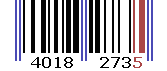
| Character Set | Length | Check Digit | Size, Module Width X, Print Ratio |
| numeric [0..9] | 7 usable digits | 1 check digit | font size SC2 (SC0-SC9); H=21.64mms (17.7-43.28); B=26.73mms (21.87-53.46); X= 0.33mm (0.27-0.66); variable size between 80%-200%; |
| Applications | European retail product marking (EAN); compressed code for products with limited label space; unique number (central managed) identifies | ||
| Notes | EAN8 data consists of 2-3 digits of country code and 4-5 digits of article code (limited numbers) | ||
EAN8 P2
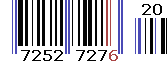
| Character Set | Length | Check Digit | Size, Module Width X, Print Ratio |
| numeric [0..9] | 7 + 2 digits | 1 check digit | refer to EAN8 (parameters for article field) |
| Applications | For magazines and paperbacks | ||
| Notes | Identical to EAN8 but 2 additional digits (e. g. for weight, pricing) can be encoded. | ||
EAN8 P5
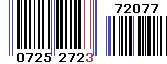
| Character Set | Length | Check Digit | Size, Module Width X, Print Ratio |
| numeric [0..9] | 7 + 5 digits | 1 check digit | refer to EAN8 (parameters for article field) |
| Applications | For magazines and paperbacks | ||
| Notes | Identical to EAN8 but 5 additional digits (e. g. for weight, pricing) can be encoded. | ||
EAN13
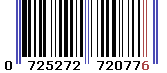
| Character Set | Length | Check Digit | Size, Module Width X, Print Ratio |
| numeric [0..9] | 12 digits | 1 check digit | font size SC2 (SC0-SC9); H=26.26mms (21.48-52.52); B=37.29mms (30.50-74.58); X= 0.33mms (0.27-0.66); variable size 80%-200%; |
| Applications | Retail product marking (European Article Numbering); number is managed by a central organization (GS1) and identifies the producer and the product; see also our FAQ. | ||
| Notes | 13 digits (12 usable digits + 1 check digit); 2 digits country of origin code + 5 digits manufacturer code + 5 digits product number; IAN + JAN are identical to EAN; the encoded number is also referred to as GTIN-13 | ||
EAN13 P2
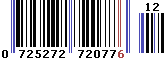
| Character Set | Length | Check Digit | Size, Module Width X, Print Ratio |
| numeric [0..9] | 12 + 2 digits | 1 check digit | refer to EAN13 |
| Applications | For magazines and paperbacks | ||
| Notes | Identical to EAN13 but 2 additional digits (e. g. for weight, pricing) can be encoded. | ||
EAN13 P5
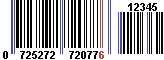
| Character Set | Length | Check Digit | Size, Module Width X, Print Ratio |
| numeric [0..9] | 12 + 5 digits | 1 check digit | refer to EAN13 |
| Applications | Encoding of the "ISBN"-number used for books (retail product marking) | ||
| Notes | Identical to EAN13 but 5 additional digits (containing the price of the product) can be encoded. | ||
EAN14

| Character Set | Length | Check Digit | Size, Module Width X, Print Ratio |
| numeric [0..9] | 2 (AI) + 13 digits | 1 check digit (EAN) | refer to GS1-128 |
| Applications | Used for encoding the 14 digits GTIN (Global Trade Item Number) from the GS1 system. The first digit is the packaging indicator, the remaining 12 digits are based on the EAN-13 / UPC-12 article number followed by a check digit. | ||
| Notes | As "carrier" bar code symbology GS1-128 with AI 01 is used. EAN-14 should not be mixed up with ITF-14. | ||
GS1-128 / EAN128

| Character Set | Length | Check Digit | Size, Module Width X, Print Ratio |
| ASCII (128 characters) | max. 48 data characters | Mod 103 | identical to Code128 but Lmax=165mm; maximum of symbol characters = 35; |
| Applications | Universal applicable such as for retail product marking or shipping (etc); GS1-128 has capabilities to encode not only the EAN number but also quantities, weight, price (and much more data) of the product. | ||
| Notes | GS1-128 is a subversion of Code 128 containing the FNC1 character at first position; GS1/EAN-128 has a predefined data format to encode various types of data into one symbol (FNC1 can function as separator of different data contents). | ||
ITF-14
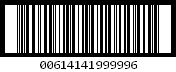
| Character Set | Length | Check Digit | Size, Module Width X, Print Ratio N |
| numeric [0..9] | 13 digits | 1 check digit | H=32.0mms; W=142.75mms; X=1.016mms; variable size: 50-100%; N=2.5:1; Bearer bar >= 2X; Quiet zone left/right >= 10X |
| Applications | The ITF-14 can represent a 14-digit article number (GTIN-14) and is usually used on transport packaging (boxes, crates, pallets...) for products in the GS1 identification system. The ITF-14 is especially suitable for direct printing on poor substrates (e.g. corrugated board) in logistics. The ITF-14 should not be used for POS scanner cash registers. | ||
| Notes | The code is based on Code 2of5 Interleaved, but has an additional bearer bar. For printing methods requiring printing plates, the nominal bearer bar has a constant thickness of 4.83 millimetres (0.190 inch) and must completely surround the symbol; in all other cases a horizontal bearer with a minimum of twice the module width is sufficient. Note that the left and right quiet zones must be at least 12 times the module width, otherwise the rectangular bearer bar will not be activated. Further information can be found here. | ||
UPC Version A
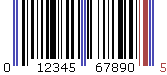
| Character Set | Length | Check Digit | Size, Module Width X, Print Ratio |
| numeric [0..9] | 12 digits | 1 check digit | H=26.26mms (21.48-52.52); B=37.29mms (30.50-74.58); X= 0.33mms (0.27-0.66); variable size; tolerances: 15-30% (0.05-0.1mms) |
| Applications | Retail product marking (use with point-of- sale cash register systems); assignment of numbers is controlled by GS1 to identify the manufacturer and the product; | ||
| Notes | The number has 12 digits (11 usable digits + 1 check digit) that consists of 1 system digit + 5 digits manufacturer code + 5 digits product number; the encoded number is also referred to as GTIN-12. | ||
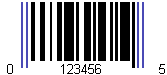
UPC Version E
| Character Set | Length | Check Digit | Size, Module Width X, Print Ratio |
| numeric [0..9] | 7 digits | 1 check digit | 1;2;3;4;1;2;3;4 |
| Applications | Retail product marking and small article bar-coding. | ||
| Notes | The code must begin with “0” or “1”. TBarCode: The check-digit is computed automatically if it is not specified in the input data (that is when only 7 digits are used for creating the code). | ||
 |
X ... Module width Pr.. Print ratio L... Width of barcode H... Height of barcode |
b ... Width of bars/spaces e... Distance between bars p... Distance between characters |